Calendar
Be the best of yourself
光剑美高彰显在全球教育领域的卓越实力
 GUANGHUA ACADEMY >
 Beyond the Classroom: Exploring the Pulse of Life — A Journey of Culture, Connection, and Continuity
How does a city's memory remain eternal through the passage of time? The answer hides in the plane-tree-shaded alleys, in the stories whispered by the elderly, and in the digitally restored murals of ancient grottoes.
When 3D modeling technology brings the Kizil Grottoes back to life in an art museum, and when students’ paintings are preserved through heat printing onto canvas, we begin to understand what it means to let time stand still — to allow what once faded to breathe again, and to let individual creativity find its way to eternity.
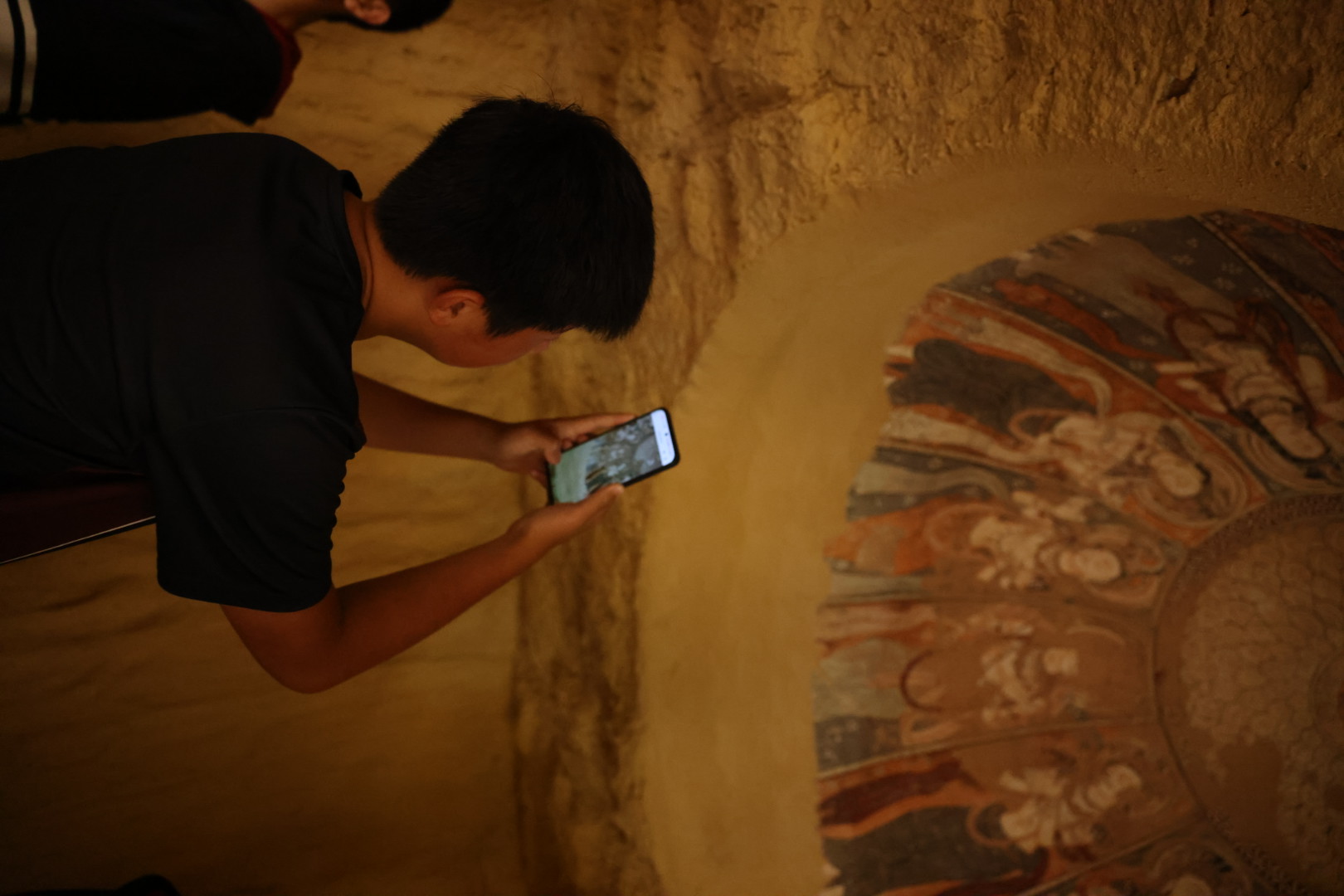
Students from Guanghua Academy ventured through the old streets of Shanghai, explored the Museum of Modern Chinese Publishing and the Liu Haisu Art Museum, and reunited with their friends at Star Bazaar, a center supporting children with autism.
It is through these vivid encounters that they witnessed how a city thrives amid the coexistence of old and new, and how its spiritual essence endures through the ever-changing tides of time.
We document, create, and pass on — not only to preserve the past, but to build a tangible and authentic future, where every street holds memories, every youth is cherished, and every touch of history becomes a new beginning for mutual understanding.
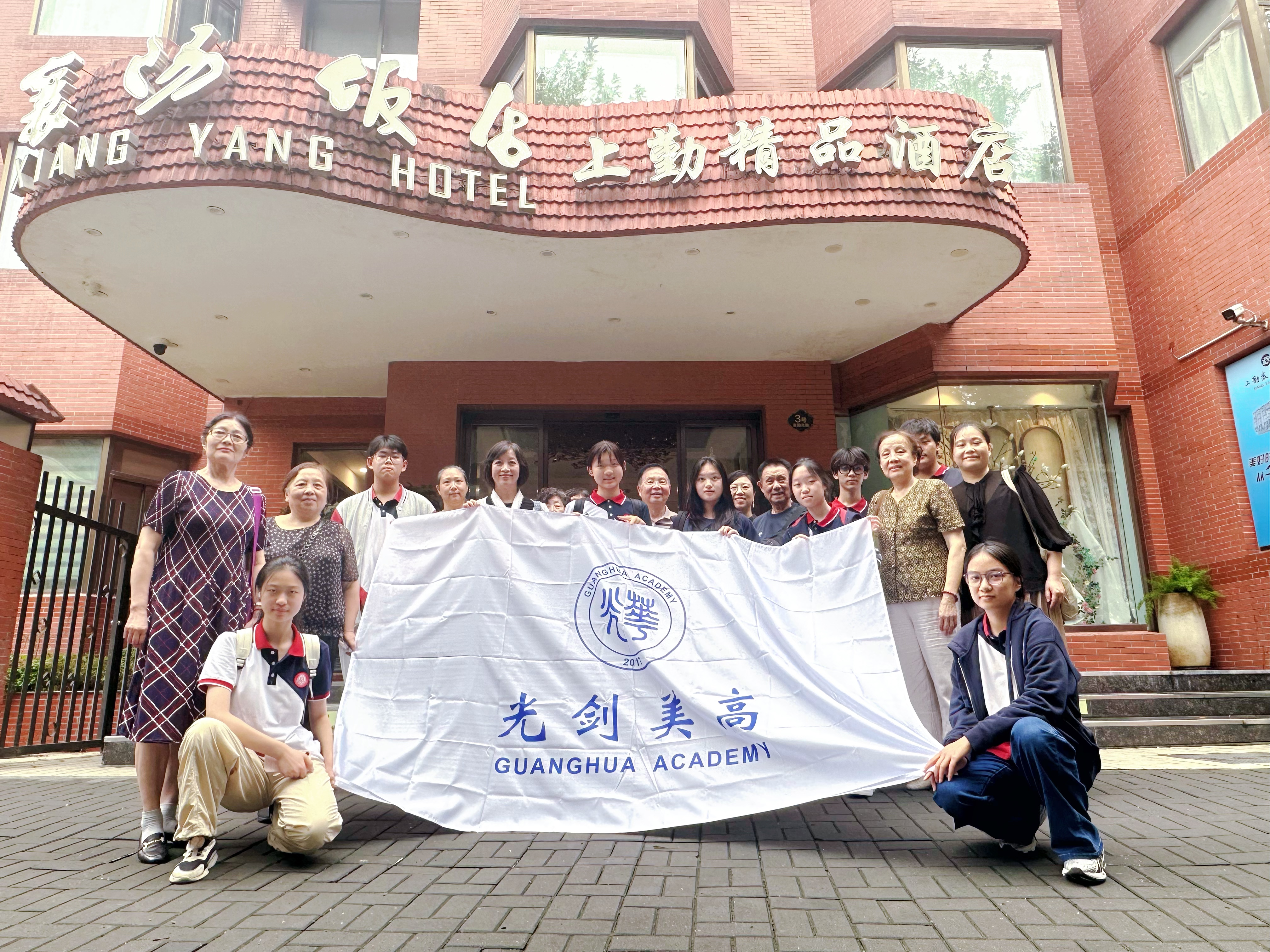
On Chongyang Festival, students strolled hand in hand with elderly residents through the “Jufu-Chang” neighborhood.
In the drizzle that brightened the plane leaves, G10-1 student Zhu Jiaqi entered, for the first time, a world he had only known online. Holding his camera on Julu Road, he kept adjusting the aperture until a silver-haired gentleman pointed to a corner shop:“That used to be a tobacco store. After school, we came here to buy dried jujubes.”
Through the viewfinder, the gray walls and iron doors suddenly came alive — he could almost see the boys in crisp shirts cycling by, hear the hiss of steam from an old tiger stove.
In Fumin Road’s pocket garden, an elderly lady waved for the students to take her picture with her beloved old street.At that moment, Zhu realized what makes the perfect composition — a century-old restaurant standing beside a new café, like longtime neighbors sharing time’s quiet flow.Their group photo in front of the Paul Restaurant captured more than smiling faces: the aroma of sweet-and-sour dishes, ivy climbing the brick wall, and an auntie humming Shanghainese opera with a basket in hand.

For G11-3 student Yong Yifan, the most memorable part was listening to stories from the past. “One retired teacher described mornings on Fumin Road in the 1980s — narrow alleys alive with chatter and bicycle bells.”
These stories wove an old-time tapestry, inspiring reflection: how many stories have these silent buildings witnessed? Whose youth once burned here — and whose dreams are now taking root?
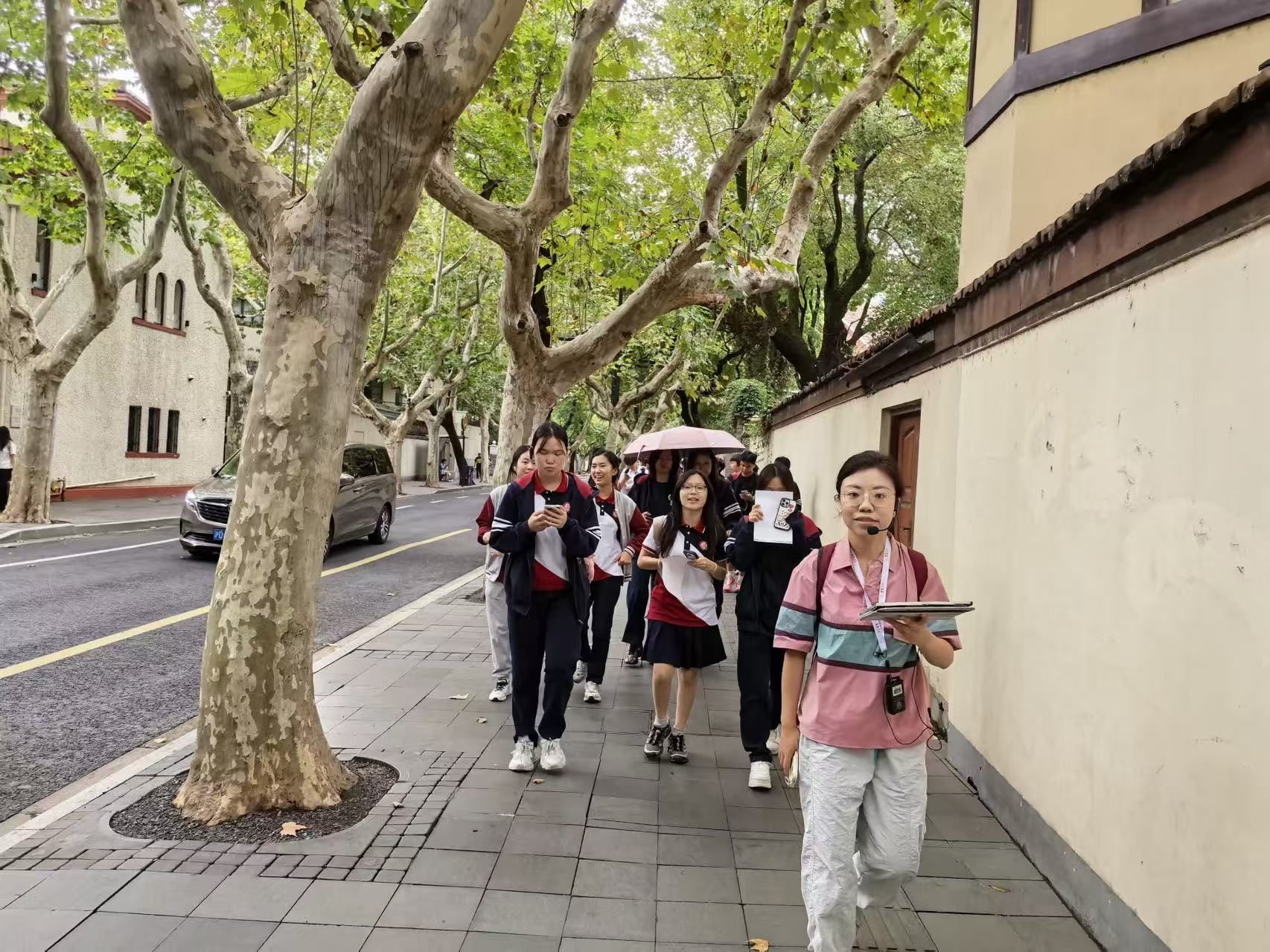
During the “Wukang Road City Walk”, students explored architectural heritage through real-life observation and decoding tasks.
“The house preserved every detail — kitchen utensils still on the shelf, books piled high, as if time had stopped,” recalled G11-3 student Wu Wenbo, describing a famous residence still inhabited today.
Students matched historical photos with existing buildings, identified Mediterranean and English-style façades, and in doing so, developed an intuitive appreciation of architectural beauty.
G11-2 student Feng Xinyi reflected on their final stop: “The He Ling Residence felt incredibly real — the furniture, the dust, even the air seemed to tell a story. And yes,” she added with a smile, “the bakery we found nearby made the day even sweeter.”
In these explorations, every street ceased to be just a line on a map — it became a living page of history.
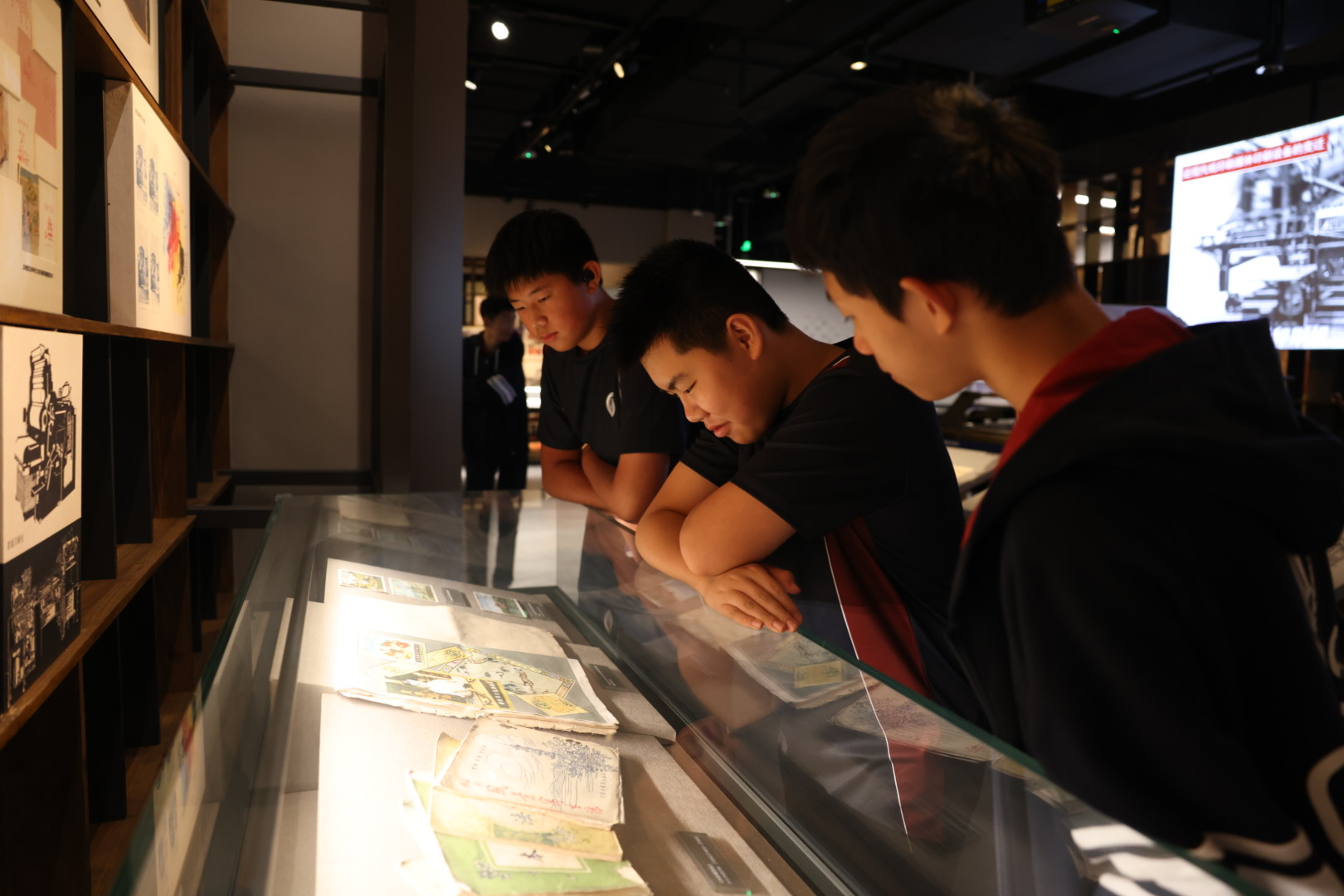
Stepping into the museum was like traveling through time — a century of printing and publishing unfolded before the students' eyes.
Interactive digital screens allowed them to “touch” history, and a reconstructed Digital Grotto, created through 3D scanning and modeling, brought the Kizil murals back to life, bridging millennia of culture through technology.
“I never imagined that printers in the Republican era used ox power to drive machines,”said G11-1 student Ying Yurui, deeply moved by the perseverance of those who spread culture in scarcity.“Their dedication was almost spiritual.”
For G10-3 student Yang Zihan, the evolution from woodblock to movable type to lithography was eye-opening:“When I saw the section ‘Farewell to Lead and Fire,’ I realized that printing isn’t just technology — it’s power. It carries ideas out of chambers and into the world.”
Through real scenes, artifacts, and interactive discovery, students heard echoes of the past — and understood that new stories are always being written.
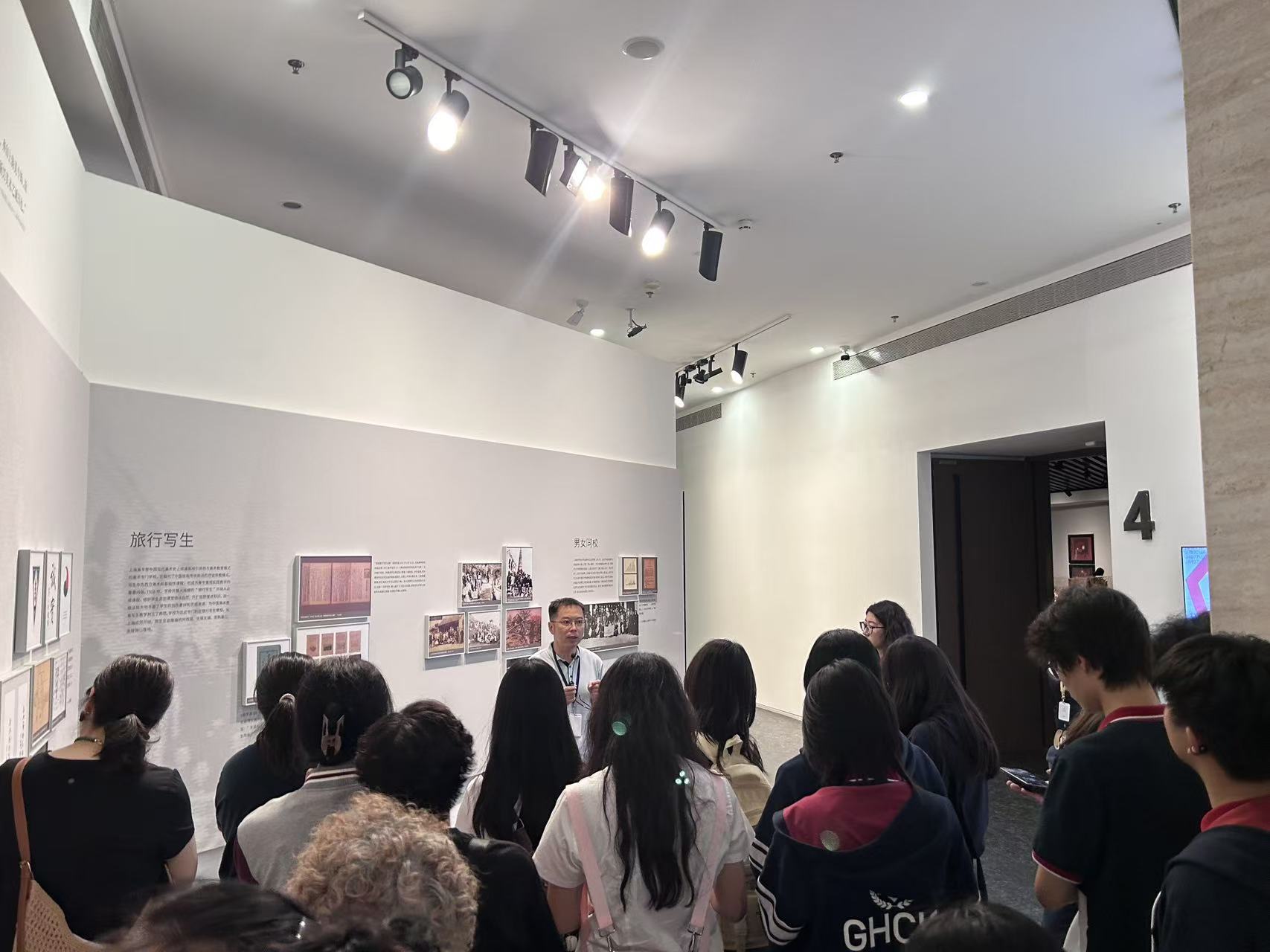
The journey continued at the Liu Haisu Art Museum, named after the pioneer of modern Chinese art education. Guided through the exhibits, G10-2 student Chen Zhiyuan learned how Liu Haisu bridged Eastern and Western art traditions:“His works broke conventions, combining plastic, metal, and photography with classical themes — it inspired me to rethink creativity.”
G10-2 student Xu Mingyue was impressed by Liu’s educational vision — founding China’s first modern art academy and inviting figures like Cai Yuanpei and Hu Shi to promote aesthetic education.
“He was bold and forward-thinking — introducing life drawing and studying abroad at a time when such ideas were revolutionary.”
Looking at a collaborative painting Fish and Wisteria by Liu and his nephew, Xu reflected:“The fish is vivid and precise, the wisteria flows freely — it’s like two voices whispering across generations.”
Art gives form to thought; publishing gives thought wings. Together, they preserve the eternal dialogue between creation and civilization.
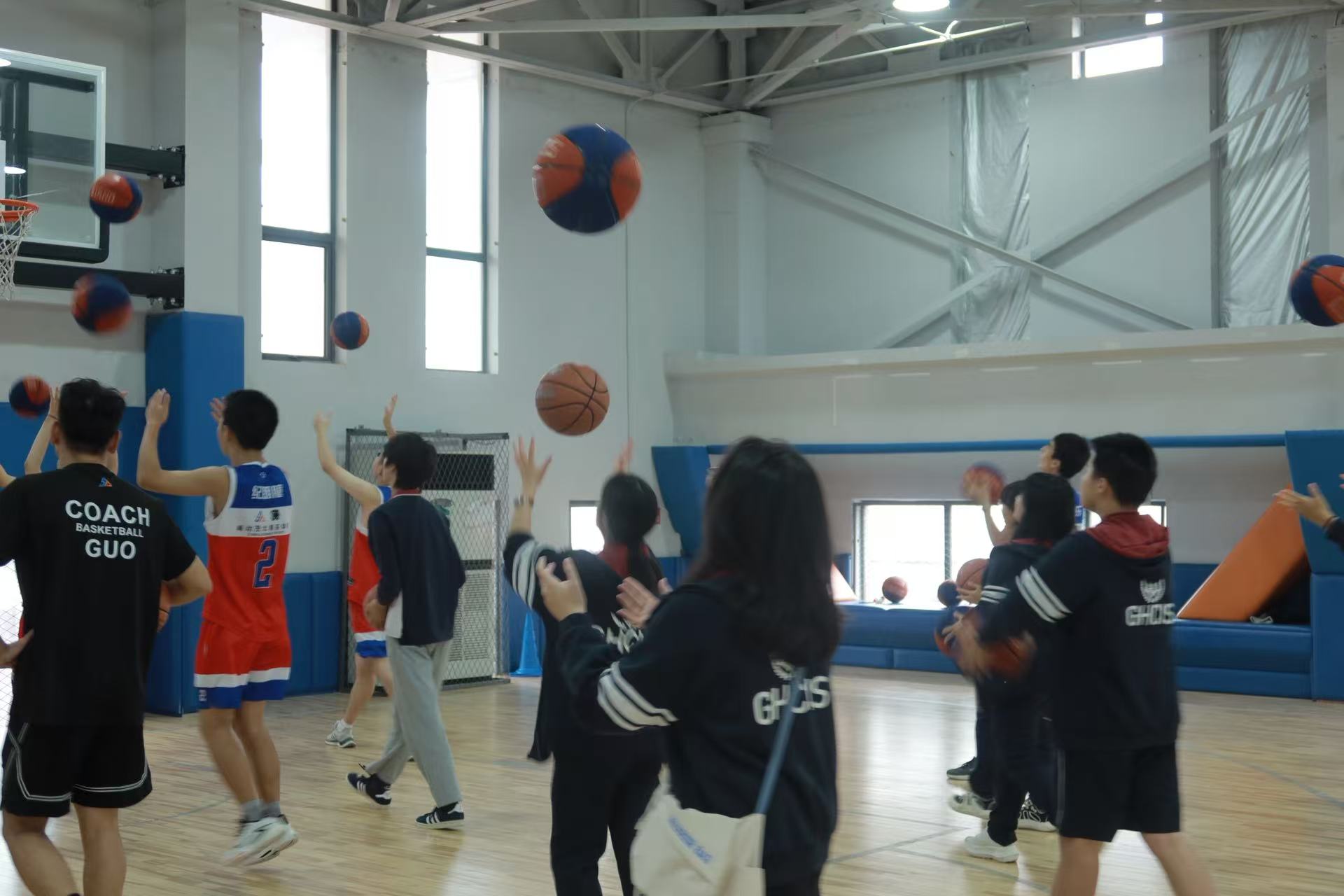
Eternal, too, is friendship. Over two years of interactions, Guanghua students have built strong bonds with the children of Star Bazaar — “We played football, sang, danced, laughed, and grew together.”
Reuniting on the basketball court, pairs of students and children practiced dribbling, passing, and finally scored together. For G11-3 student Zheng Manling, who joined for the second year, the experience was heartwarming:“Staying connected makes me happy. I'll keep coming back.”
G10-3 student Hou Jiayuan admitted she first joined out of curiosity about “supporting special needs communities,” but soon found deeper understanding:“My partner was incredibly smart, and even when communication needed help, we connected through smiles.”She even brought candies to share — small acts that sweetened the moment of connection.
Through patience and kindness, every dribble, every exchanged gift, and every word of encouragement became a silent language of empathy. The students gained more than volunteer experience — they discovered what it means to understand, accompany, and embrace difference.
Time passes, but friendship remains timeless.
Every road we walk, every person we meet, silently shapes our understanding of the world. These moments teach us that the flame of civilization lives not only in grand narratives, but in every quiet act of goodness.
Time will keep flowing, yet these memories have already become eternal.
We believe: when young hearts learn to listen to history’s echoes and embrace life’s diversity, they are not just learning — they are writing one of humanity’s most beautiful stories — a story of beauty, of love, and of the never-ending pursuit of understanding and creation.